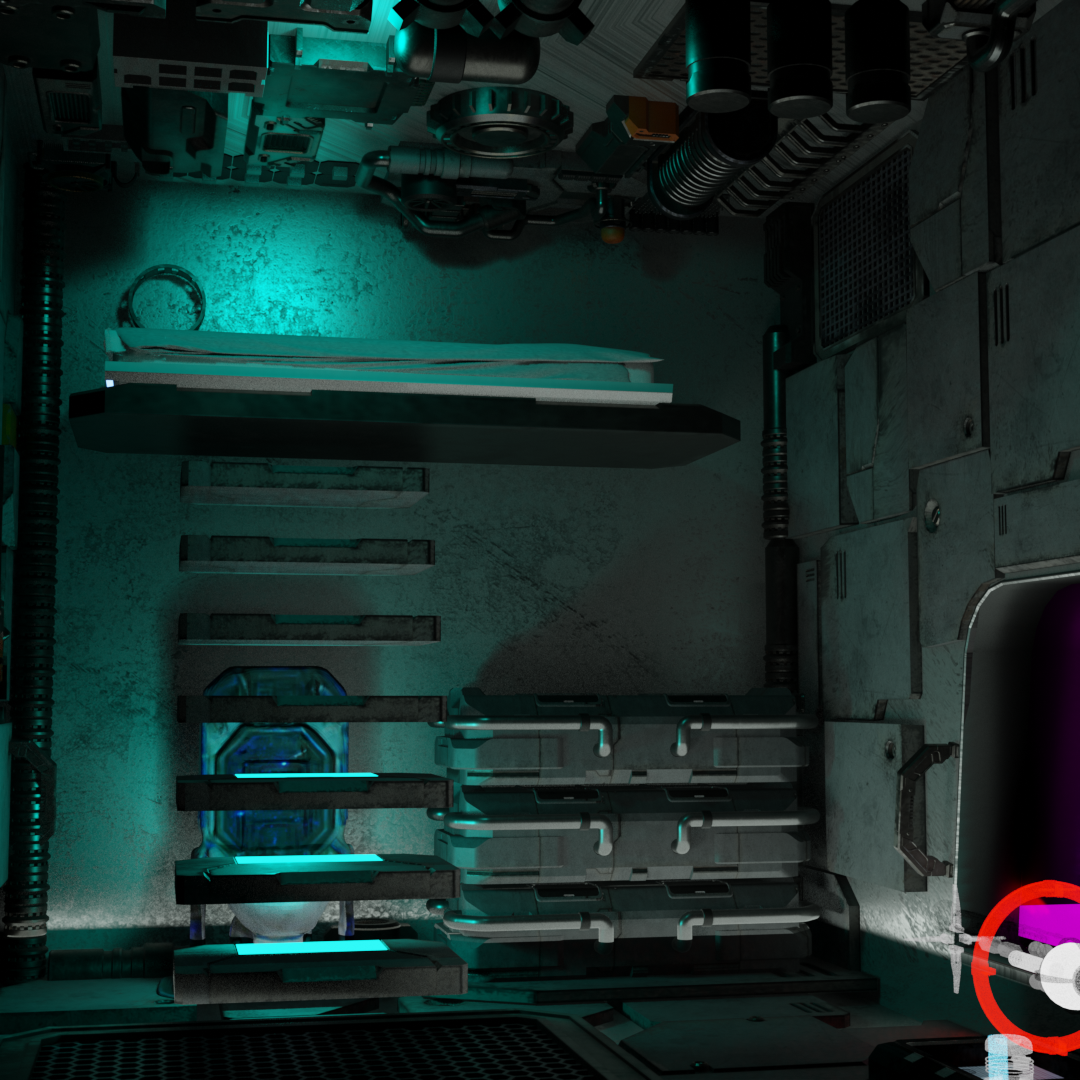
Environment & assets
Designed the building interior and created structural, medical and environmental props for real-time use.
Production case study
A contained open-world horror experience built inside a fully designed building interior.
The brief
COMATOSE was developed as a 15-person multidisciplinary Brock University studio project. The goal was to create an open-world experience contained within a building, using environmental variation, interactive props and systemic feedback to keep exploration readable.
My contribution crossed the boundary between art and implementation: building interior content, creating and integrating props, supporting lighting and VFX, implementing player-facing menus and helping program character movement.
My contribution
Designed the building interior and created structural, medical and environmental props for real-time use.
Carried content from DCC creation into Unity, supporting scene assembly, colliders, lighting, post-processing, VFX and interactive audio.
Built pause and startup menus and contributed to character movement, pickup interactions and player feedback.
Player-facing systems
The menus extend the environment’s distressed visual language while keeping the essential game states and audio controls clear.
Primary game entry and audio controls.
Resume, exit and layered audio settings.
Player feedback supporting exploration and puzzle-solving.
Compact item and slot communication.
From asset to engine
Scene assembly connected authored props with cameras, colliders, scripts, lighting and navigation inside the larger hospital environment.
Environment assembly and scene organization.
Wheelchair integration, placement and collision setup.
Camera, lighting and prop integration.
Item data, script and collider configuration.
Asset pipeline
Reference, topology, materials and engine integration were treated as one continuous workflow rather than separate tasks.
Reference image used for form and function.
Low-poly functional cabinet with opening components.
Finished medical environment prop.
Modeled and textured environment asset.
Wireframe and cable construction.
Material and lighting development.
Additional production evidence
Supporting captures document the smaller assets and iteration work that helped the larger environment feel inhabited and interactive.
Small narrative prop development.
Player-view body-part development.
Secondary angle showing topology and cabling.
Early wall, floor and mood development.
Outcome
The final production combined environment art, technical implementation, UI and gameplay support within a shared 15-person pipeline. It strengthened my ability to move work from an idea, through asset development, into an interactive Unity scene.